
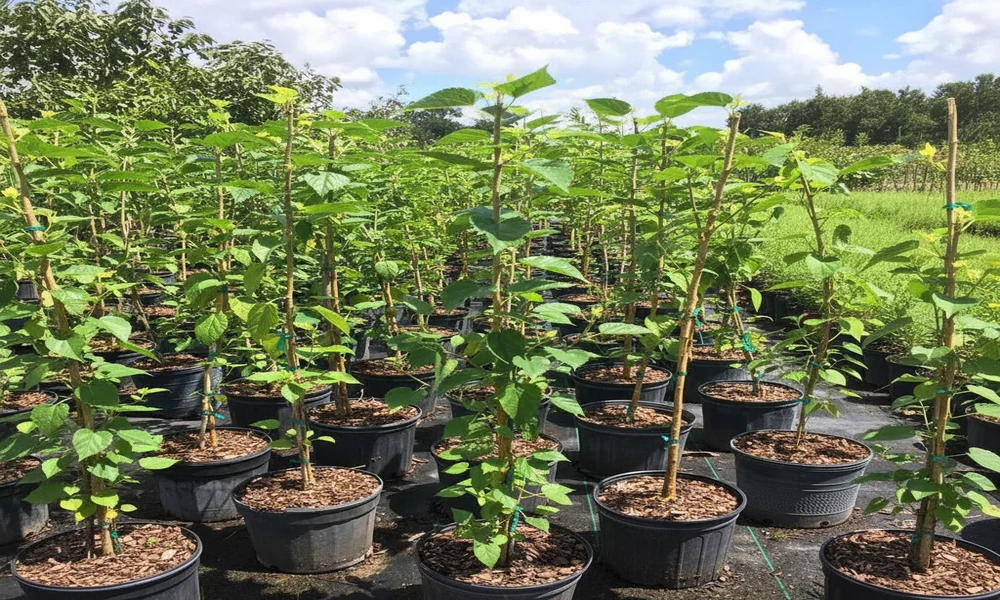
A beautifully flavoured apple can still disappoint in a favourite recipe if its flesh behaves differently from what the cook expects. Slices intended for an open tart disappear into softness, while a sauce stays stubbornly chunky. For gardeners choosing a tree, that distinction deserves attention before colour, familiarity or a photograph of the crop settles the decision. The useful question is what the household actually wants to make. A tree chosen with those dishes in mind has a clearer purpose from the outset.
Matching Fruit Trees for Sale to the Texture You Want in the Kitchen
Think of three familiar results: a smooth spoonful of apple sauce, a crumble with soft fruit beneath the topping, and a tart with recognisable slices. These are different cooking tasks. The word culinary identifies a broad use, but it does not tell you exactly which of those results a particular apple will produce.
The specialist nursery ChrisBowers notes that dual-purpose apples deserve closer consideration in its published assessment of garden varieties. Its discussion of Idared distinguishes an apple that retains texture during cooking from one that merely becomes sweeter as it is kept. The guidance describes Idared as suitable for cooking earlier in its season and for eating fresh later, while pointing out that some other culinary apples remain rather coarse when eaten raw. That distinction gives the cook a more precise basis for comparison than the broad cooking or eating labels alone. The same published selection also acknowledges the personal judgement involved in recommending varieties: flavour, dependable cropping and the usefulness of the fruit all enter the decision. For someone comparing the wider selection presented here, the practical implication is to read the description of the flesh as carefully as the name of the apple, then relate it to a dish the household regularly enjoys.
A cultivar is a named variety with recognisable characteristics. Its cooking description may mention breaking down, keeping its shape, a sharp flavour or a tender texture. Those phrases are more useful when translated into the job required. An apple that collapses readily is attractive for purée; that same quality may be inconvenient when arranging a patterned topping.
Write down the dishes you make most often, rather than an ambitious list of recipes you hope to try once. If apple sauce appears every week and decorative tarts rarely do, a reliable purée apple deserves priority. Two households with identical gardens may reasonably choose different varieties because their kitchens ask different things of the harvest.
Choose a Cooking Apple for the Softness You Need
For sauce and smooth fillings, look for a cultivar specifically described as cooking to a purée. The familiar Bramley’s Seedling is associated with this result, but it is not the only option. RHS descriptions identify Grenadier as producing a sharp purée, while its pocket guide describes Lane’s Prince Albert and Dummellor’s Seedling in similar terms. These are useful examples of a trait to investigate, rather than a ranking that makes one tree best for every British garden.
A purée apple also contributes flavour, so consider how the finished dish will be served. A tart sauce alongside a savoury meal has a different role from a mild filling eaten with custard. The amount of sweetness you enjoy is personal and the recipe influences it. A cooking label does not instruct every household to add the same quantity of sugar. Taste the prepared fruit and adjust the dish according to its use, instead of treating sharpness as a defect in the cultivar.
The crumble question is particularly revealing. Some cooks want a soft, unified filling; others want pieces of fruit beneath the topping. Either preference is reasonable, but the same supermarket description of a cooking apple will not resolve the choice. If your favourite crumble contains distinct chunks, test a shape-holding apple or a mixture before committing to a tree selected solely for its reputation as a cooker. A familiar dish can conceal a quite specific texture preference.
Consider when the kitchen needs this fruit. Grenadier is an earlier culinary apple, with nursery descriptions placing its season around August and September. That makes it a different proposition from an autumn cultivar intended for later use. An early harvest may suit fresh sauces and summer baking; a household mainly baking during winter needs to consider a later season or its own storage arrangements. Start with that practical fit rather than expecting every cooking variety to supply the same months.
Look for Shape Retention When Slices Matter
In an open tart, the arrangement of fruit is part of the result. A cultivar that retains its form after cooking gives the cook greater control over that arrangement. James Grieve is described in RHS cultivar guidance as keeping its shape when cooked, making it a useful candidate to investigate. This does not promise identical results in every oven. It provides a more relevant starting point than choosing whichever apple has the brightest skin, especially when that skin will be peeled away.
Slice size and recipe method still matter. Compare two pieces of very different thickness and you are testing preparation as well as fruit. When assessing a new variety, make the pieces reasonably similar and use the same recipe. A thin fan of slices on pastry and a thick wedge in a covered pie are different tests. Record which one you tried so that a successful result can be repeated rather than remembered simply as an apple that cooked well.
Shape retention is not the same as hardness. The desired result is usually fruit that becomes pleasant to eat while remaining identifiable, not a slice that resists the fork. Taste the cooked sample as well as examining it. A neat arrangement that feels unappealing offers little advantage. Conversely, an apple that loses some definition may be entirely suitable for a family pie where flavour and tenderness matter more than the appearance of individual slices.
For a mixed filling, the contrast itself can be useful. Consider a hypothetical pie made with one apple that softens readily and another that keeps more of its form. The cook is seeking a soft surrounding mixture with recognisable pieces. Test that idea using bought or locally obtained fruit before planting two trees to supply it. There is no need to invent a fixed proportion in advance: the preferred balance belongs to the recipe and the household, and may change with the fruit available.
Treat Dual Purpose as a Starting Point for Questions
A dual-purpose apple offers both culinary and dessert use, but the label leaves several questions unanswered. Does the fruit taste pleasant raw as soon as it is picked, or after a period of keeping? Is it useful for sauce, baking or both? Does cooking emphasise a flavour the family enjoys? The appeal of serving two purposes from one tree is obvious in a limited garden, yet that benefit is strongest when both purposes match real habits.
Bountiful illustrates why the description beneath the label deserves reading. The nursery’s cultivar information describes fruit sweeter than many culinary apples and notes that stored fruit can be eaten fresh later in winter. That is a specific pattern of use rather than a promise that every apple will be equally suitable for every dish on picking day. A gardener who wants fruit for lunchboxes immediately at harvest should ask a different question from someone planning winter baking and occasional fresh eating.
Charles Ross provides another useful comparison. The RHS pocket guide describes it as an eating apple that also bakes well. Rather than arranging varieties on a single scale from good to bad, compare their proposed roles. One household might value an apple primarily for fresh eating, with baking as a secondary use. Another might choose principally for cooking and regard later dessert quality as a bonus. Calling both choices dual purpose does not make those priorities interchangeable.
Be wary of trying to make one tree satisfy every possible use. A broad-use cultivar may be a sensible compromise, but a compromise should be chosen knowingly. If the household strongly prefers a very smooth sauce and also a particular crisp eating apple, two appropriate trees may serve it better where space and pollination allow. Where only one fits, identify the principal use first. The occasional purchase of another type of apple is a practical solution, not evidence that the garden choice has failed.
Run a Small Comparison Before Choosing a Tree
Whenever possible, taste fruit from the shortlisted cultivars before buying the trees. An apple day, local grower or seasonal market may offer named fruit that ordinary shops rarely stock. Keep the identity attached to each sample. A pleasant unnamed apple is enjoyable, but it cannot reliably guide the purchase of a specific cultivar. Ask when the fruit was picked and whether it has been kept, because that context helps explain what you are tasting.
A simple home comparison needs only a familiar recipe and a little care over preparation. Try each cultivar separately first, using similar quantities, comparable pieces and the same cooking method. Make a note of whether the fruit becomes smooth, stays in pieces or falls somewhere between. This is an informal household trial, not a laboratory assessment. Its value lies in making your own preference visible, rather than producing a score that claims to apply to everyone.
Taste with the intended accompaniment too. An apple that seems very sharp alone may fit a sweet pastry or custard, while a milder one may be preferred with little added sweetness. If sugar or spice is added at the outset in different amounts, the comparison becomes harder to interpret. Keep the first preparation straightforward, then adjust a second small portion as you normally would. Record the adjustment so that the final choice reflects the finished dish, not just the raw sample.
Repeat a promising test if the first result is uncertain. One unusually immature sample, a different recipe or a much longer cooking time should not decide a tree that may occupy the garden for years. You need not search endlessly for perfection; two or three clear observations are often enough to narrow the choice. A short note such as keeps slices in our tart or makes the sauce we prefer is more useful at ordering time than a vague memory that an apple tasted rather nice.
Turn the Kitchen Shortlist Into a Growing Decision
The final selection must work outside as well as inside. Take the shortlist to a nursery with information about the available space, soil, exposure and intended tree form. A desirable cooking characteristic does not cancel a poor match with the garden. Ask for the cultivar on an appropriate rootstock, the lower part of a grafted tree that strongly influences its size and vigour. A famous name offered as a large tree is not interchangeable with the same cultivar supplied for a restricted space.
Confirm pollination before treating two culinary favourites as a complete planting plan. Most apples need compatible pollen from another cultivar flowering at a suitable time. Some, including Bramley’s Seedling, are triploids and are poor providers of pollen for other trees. This complicates a small isolated planting. Existing suitable apples nearby may contribute, but do not assume that an unidentified neighbour’s tree settles the matter. A nursery should check the proposed combination rather than simply approving two different names.
Use the season of use as part of the decision, while keeping expectations realistic. A household that cooks little during the summer holidays may find an early glut inconvenient, however good the fruit. Someone who regularly makes sauce in August may value exactly that timing. Think about the amount you are likely to use and the work of picking it. A manageable harvest that reaches the kitchen is more useful than choosing solely for descriptions of exceptionally heavy cropping.
The most productive next step is a short brief: the dishes you want to make, the texture you prefer, when you expect to use the crop and the space available for the tree. Add any results from tasting named fruit. That gives the supplier something concrete to work with and helps you assess alternatives if the first choice is unsuitable. The eventual apple need not be fashionable or unusual. It needs to grow well in its position and behave in the kitchen in a way the household values.